



First-ever excavation of prayer house, which served as spiritual center of Lithuanian Jewry before being destroyed by Nazis and Soviets, uncovers platform for reading Torah and other remains
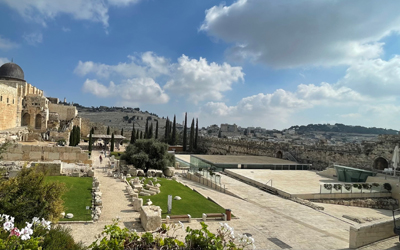
Decades after one of Eastern Europe’s most important synagogues was destroyed under Nazi and Soviet rule, archaeologists have uncovered the central dais, or bimah, of the Great Synagogue of Vilnius, Lithuania.
Excavators were able to access the site for the first time after a Soviet-era building that stood over it was destroyed about eight months ago, excavation co-director Jon Seligman of the Israel Antiquities Authority told The Times of Israel. The synagogue, which served as the center of the city’s 60,000-strong Jewish community before the Holocaust, was ransacked by the Nazis in 1941 and then destroyed under the Soviet regime in 1957, he said.
“This was the most important synagogue of Lithuanian Jewry for several centuries,” said Seligman. “It’s what represented them as a people and formed a part of their identity. At a time when Jews comprised 40 percent of the city, this was their cathedral.”
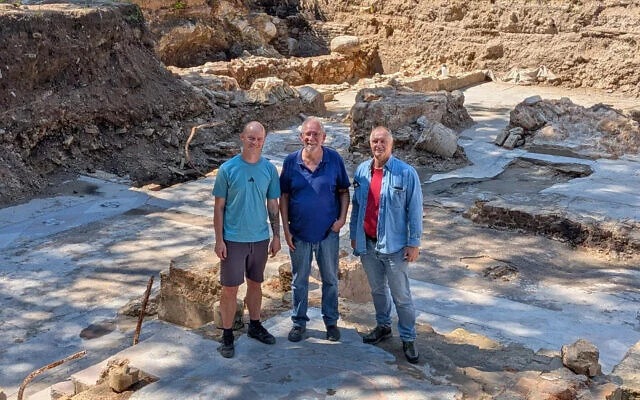
The bimah, a raised platform from which the Torah was read, was uncovered during the past month in excavations that also uncovered sections of the main prayer hall, parts of the women’s gallery, colorful terrazzo floors, seating plaques bearing the names of worshipers, and a plaque engraved with the Ten Commandments.
The findings are the most significant since excavations on the city’s central Jewish compound, the Shulhoyf, began in 2011. The current excavation is the sixth at the site, which until now has focused on the courtyard and playground areas around the building.
“My family came from towns around the Vilnius region, so this project has been a homecoming for me in a lot of senses,” Seligman said.
The excavation is being led by the Israel Antiquities Authority and the Lithuanian cultural heritage organization Kultūros Paveldo Išsaugojimo Pajėgos (KPIP), with funding from the Good Will Foundation and in cooperation with the Lithuanian Jewish Community.
Reconstructing history
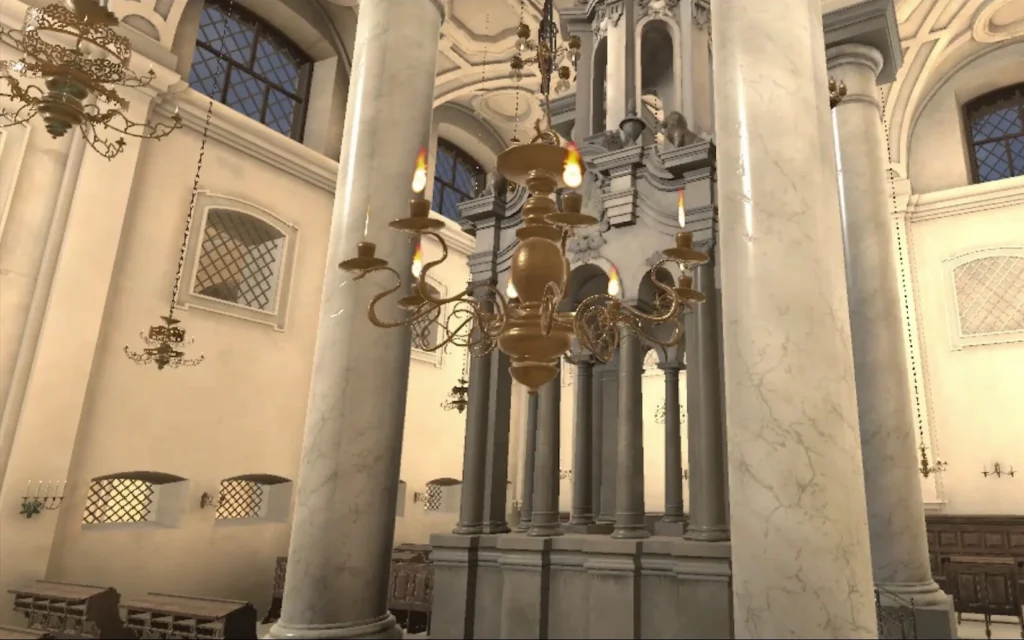
Jews first settled in Lithuania when they were invited by the Grand Duke in the 14th century, and they built a large wooden synagogue in Vilna, as the city was then known, that was destroyed in a riot at the end of the 16th century, Seligman said. Following that tragedy, the community received permission to build a large brick synagogue in Baroque style, which became the Great Synagogue.
“It was the very largest building of its type in Europe,” Seligman said. “We’re talking about a nine-bay synagogue with four central columns, and it was the most dominant building of the area.”
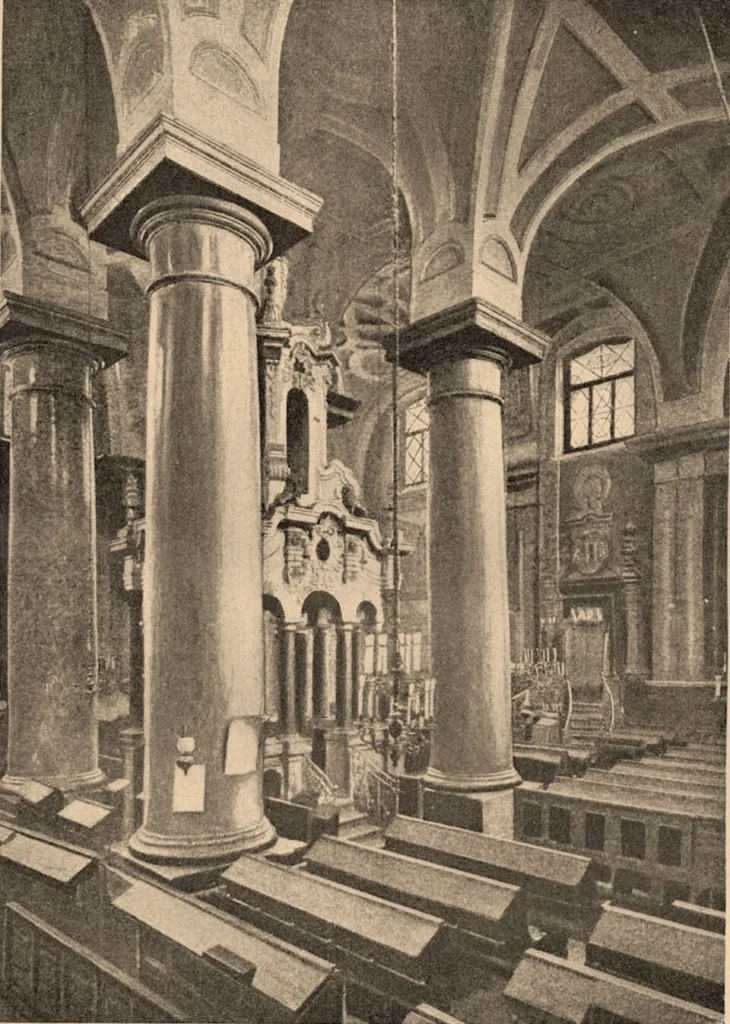
The synagogue stood at the heart of the Shulhoyf, a dense Jewish communal compound that included houses of study, a bathhouse and other institutions, functioning as the central religious and communal institution for Lithuanian Jewry.
In the years before the Holocaust, Vilna’s Jews were known for their vibrant mix of religious learning, secular scholarship, political movements and cultural life, Seligman said.
“This was a really active, vibrant, argumentative Jewish community with lots and lots of different kinds of strands of Jewish life, from Zionism to Bundism,” he said.
By the eve of World War II, Jews made up roughly 40% of the city’s residents, with about 60,000 to 70,000 Jews living there and some 160 synagogues across the city, Seligman said. Only one synagogue in Vilnius remains in use today.
After the Nazis occupied Lithuania in June 1941, Vilna’s Jews were forced into two ghettos, known as the “Large Ghetto” and the “Small Ghetto.” The Great Synagogue was located within the Small Ghetto, where the Nazis sent older people and women with small children they considered “not useful” for the war effort, Seligman said. In October of that year, the Small Ghetto was liquidated and its inhabitants murdered.
“The Great Synagogue was ransacked and burned during liquidation, but it was still standing and restorable by the end of WWII,” Seligman said.
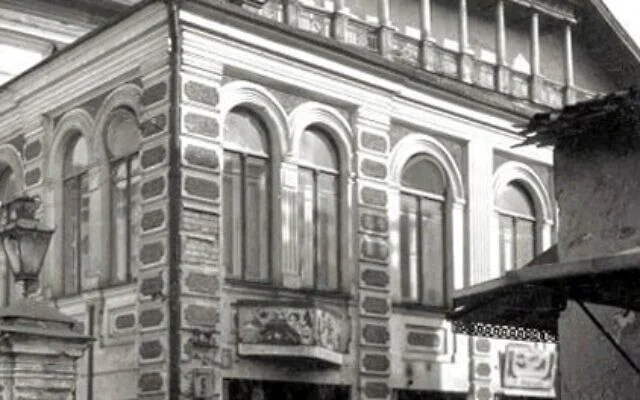
In the postwar years, early Soviet authorities initially granted the building protected status, but removed that status in 1957 as part of an urban redevelopment scheme, Seligman said. They demolished the synagogue and built a school on top of the site.
That building was vacated about a decade ago and demolished last year, creating the possibility of excavating the site for the first time.
An architectural decision made hundreds of years earlier allowed for much of the synagogue’s interior to outlive the Soviet building, Seligman said.
“The original synagogue was built one story below ground level in order to increase its internal height,” he said. “The bottom floor was saved because it was lower than the school building itself.”
The excavation revealed extensive and continuous sections at the heart of the building, Seligman said in a joint statement with Justinas Račas of the KPIP. “The main prayer hall, paved with colorful terrazzo floors decorated with floral and geometric patterns; plaques bearing names; and many other finds… offer us a moving, almost personal encounter with the people who prayed here and with the community life that developed around the synagogue over the course of centuries.”
Among the findings are a large number of plaques marking the permanent seats of worshipers in the synagogue. Some bore the names of women who prayed in the women’s gallery; others bore the names of men. Additional plaques marked seats allocated to members of a major charitable society involved in the administration of the Jewish community.
One prominent plaque marked a seat donated by “Gitel Klachek, wife of the late Yechezkel, Shamash d’Mata” — that is, the city sexton.
The Klachek family was a wealthy and influential family that owned numerous businesses in the streets surrounding the Great Synagogue, said the IAA in a statement. Yechezkel was apparently a public official who served the city’s Jewish community, it said.
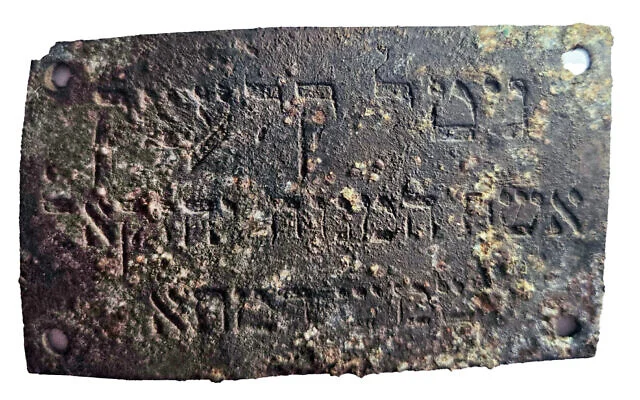
Other finds included a small metal plaque engraved with the Ten Commandments, a template imprinted with the opening word of Genesis, and plates used during the Passover holiday, Seligman added.
Looking forward, the site will be developed as a heritage and memorial space to the community, Seligman said. With only 2,000 Jews living in Vilnius today, and minimal attendance at the city’s sole synagogue in operation, there is no need to restore it for use as a synagogue.
“But there is a need to provide memory both to the synagogue, its importance, its significance, and also to the people who lived there and prayed there,” Seligman said. “That’s the importance of this work.”
Story by: Zev Stub | The Times of Israel