

The John S. and James L. Knight Foundation is expanding its grant-making in Detroit’s neighborhoods with a new $19.8 million round of grants.
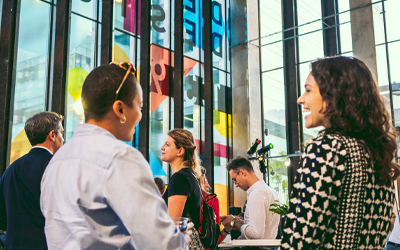
The multi-year funding, announced at a celebration of the Miami-based foundation’s Detroit partners at Michigan Central on Sunday night, will support the city’s arts and technology economy, civic infrastructure and public spaces.
“Detroit has always been a city of resilience and reinvention,” Maribel Pérez Wadsworth, president and CEO of Knight Foundation, said in a news release. “Our latest investments support a Detroit that will continue to be shaped by the creativity, talent and vision of its residents. Whether it’s transforming public spaces along the Joe Louis Greenway, expanding local residents’ economic power in tech or strengthening the city’s creative economy, these efforts reflect the energy of a city on its triumphant rise.”
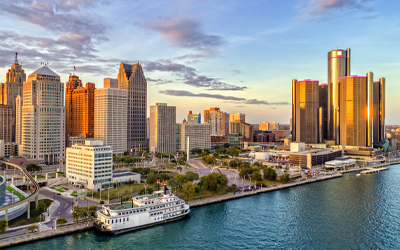
Downtown Detroit is headed in the right direction, Detroit Program Director LaTrice McClendon told Crain’s on Monday. “We want our neighborhoods to go in the same direction.”
“Detroit has always been a city of resilience and reinvention,” Maribel Pérez Wadsworth, president and CEO of Knight Foundation, said in a news release. “Our latest investments support a Detroit that will continue to be shaped by the creativity, talent and vision of its residents. Whether it’s transforming public spaces along the Joe Louis Greenway, expanding local residents’ economic power in tech or strengthening the city’s creative economy, these efforts reflect the energy of a city on its triumphant rise.”
Downtown Detroit is headed in the right direction, Detroit Program Director LaTrice McClendon told Crain’s on Monday. “We want our neighborhoods to go in the same direction.”
The foundation has been at the table in the revitalization of the city and its downtown for years, she said, pointing to, among other things, its $30 million commitment to the “Grand Bargain” that shored up Detroit’s pension funds and spun off the Detroit Institute of Arts from the city to protect its collection during the city’s bankruptcy.
On the neighborhood front, the Knight Foundation has focused funding in the city’s North End neighborhood for the last few years. The latest round of funding expands on that strategy, McClendon said.
“The neighborhoods that surround downtown (Detroit) are equally important. We are just trying to make sure that neighborhoods and downtown both have investment,” she said.
The Knight Foundation makes grants in 26 U.S. cities and towns where the Knight brothers once published newspapers, with offices in eight of those cities and partnerships with local community foundations in the other 18.
Its grants in Detroit have totaled $215 million over the past 25 years. Of that, $80 million has been awarded to local efforts in the past decade alone, supporting the arts, community and journalism, McClendon said.
Two of the grants in its latest round of funding are to nonprofits it has supported in the past, she said. They are a $2 million grant to the Museum of Contemporary Art Detroit to activate a flexible indoor/outdoor community space and $2 million to Vanguard Community Development Corp. to support completion of the North End Community Campus as a civic and cultural anchor for the neighborhood, on earlier support from the foundation.
The remainder of the new grants went to first-time grantees of Knight, McClendon said. They include:
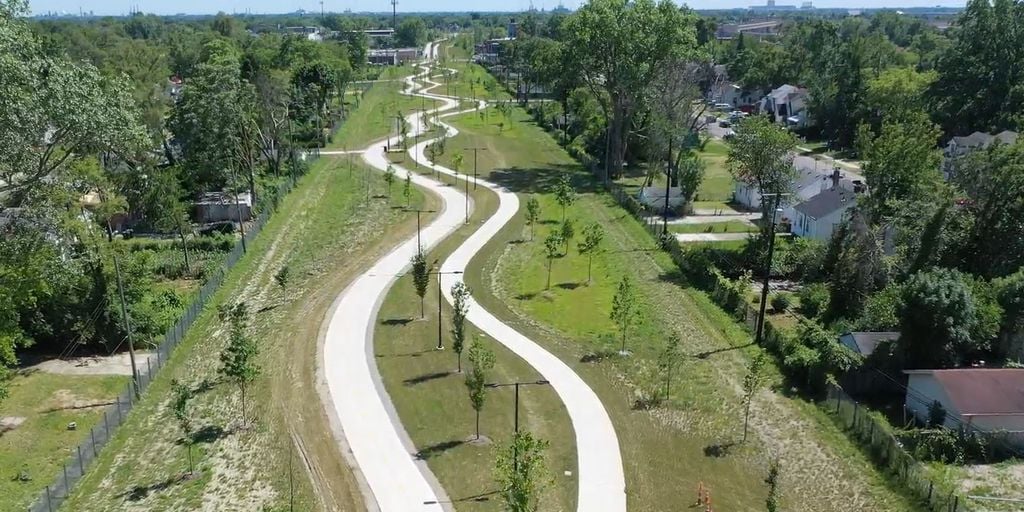
- $5 million to the Unified Greenway Project linking the Detroit riverfront to the Joe Louis Greenway and 23 neighborhoods. Half will go to the Detroit Riverfront Conservancy to support construction and the other half to an endowment at the Community Foundation for Southeast Michigan to support programming and maintenance.
- $2 million to the Joe Louis Greenway Partnership to activate a trailhead on Woodward Avenue, connecting Highland Park residents to the 27.5-mile greenway.
- $2 million to Black Tech Saturdays, which connects Black founders, entrepreneurs and tech-curious people, to scale digital infrastructure, organize convenings and expand storytelling. The grant will also help unlock $10 million in earned income opportunities for Detroiters through pathways to high-growth tech jobs and entrepreneurship — positioning Detroit as a national model for equitable tech ecosystems, Knight said.
- $1.5 million to Eastside Community Network to support completion of a 9-acre environmental and health-focused public space focused on wellness, job training and environmental resilience.
- $1 million to Detroit Horse Power to help fund the transformation of a 14-acre equestrian site in the Hope Village neighborhood into the country’s largest urban equestrian center, offering youth development through classrooms and a riding arena, and community space.
- $1 million to Give Merit-Merit Park to support the construction of public amenities and small business activation within Merit Park Plaza, which will be part of the Joe Louis Greenway. The plaza will be part of a project transforming vacant land on Grand River Avenue into a youth community hub with sports fields, outdoor classrooms, retail incubators and civic spaces.
- $1 million to Design Core Detroit/College for Creative Studies to help strengthen Detroit’s economy by supporting local creative businesses with training, funding and connections, while also positioning the city as a leading global design center.
- $1 million to Black Leaders Detroit to capitalize a no-interest loan fund for developers and entrepreneurs excluded from traditional financing, supporting community-centered projects that restore vacant homes, reduce blight and build community wealth in Detroit. The fund will support more than 30 residential projects and create more than 150 jobs across Detroit neighborhoods.
- $800,000 to Downtown Detroit Partnership to enhance some of the city’s public spaces, including Campus Martius and Capitol Park, to help ensure they are more welcoming, accessible and reflective of the diverse communities that use them daily.
- $500,000 to Rootoftwo, a for-profit, through CultureSource as fiduciary, for a project converting a decommissioned electrical substation into a civic studio for participatory governance and design. The space will support civic tech labs, digital tools and workshops aimed at co-creating just and innovative public solutions.